Wednesday, February 2, 2011

Conducting Workshop with Dr. Debra Cairns Monday February 7

The Elements of Conducting:  Getting them Started and Stopped,
and Everything in Between

MONDAY FEBRUARY 7, 2011 - 7:30 - 9:00 p.m.
First Presbyterian Church
10025 - 105 Street, Edmonton

Workshop Presenter:  Dr Debra Cairns
Presented by RCCO Edmonton Centre

Designed to provide helpful reminders for conductors and musicians who have been out in the field for many years, and to whet the appetite of those who may be beginning their conducting career or training, this workshop will focus on such conducting elements as beat patterns, cues, releases, articulation, dynamics, and tempo gradations, as well as address such aspects of technique as stance, hand and arm position, breath.  To enhance the experience, participants will be actively involved in applying the ideas within the safe learning environment of the group setting.

The workshop will be led by Dr Debra Cairns, Professor of Choral Music at the University of Alberta where she co-ordinates and co-supervises the graduate program in choral conducting, teaches undergraduate and graduate conducting, choral literature, and diction, and directs the University of Alberta Concert Choir. 

Both the Concert Choir and her community chamber choir, i Coristi, have been heard on regional and national broadcasts of the CBC and have been regular national semi-finalists and prize winners in the national CBC Radio Amateur Choir Competition.

Debra Cairns is in demand both nationally and internationally as a workshop and conference presenter, guest conductor, clinician and adjudicator.  In 2009 she published her first book, entitled Elements of Conducting.  An Instructional Manual (which will be available for purchase--$20--at the workshop). She is currently Past President of the Association of Canadian Choral Communities (founded as the Association of Canadian Choral Conductors).

Sunday, January 30, 2011

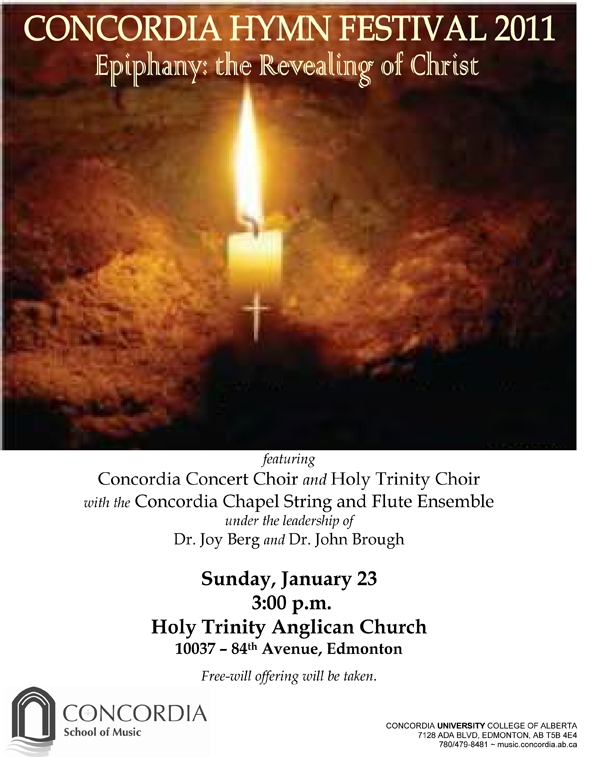
Edmonton Youth Choir - A Dessert Concert

Concert Listings January 31-February 6


FREE Monday Noon Music UofA every Monday at noon in Convocation Hall.   A different program each week, the Monday Noon Music series features everything from western classical to world music. This quick 45-minute concert leaves you just enough time to get back to class or the office before the noon hour’s even over. Don't forget your lunch!

Saturday February 5, 2011 7pm Alberta Children's Choir (Honour Choir) with the Edmonton Youth Choir's Boy's Choir, McDougall United Church.

Saturday February 5, 2011 7:30pm FREE Kanata Winds, a winter recital with reception to follow. Music, Hindemith, Kleine Kammermusik, Ibert, Trois Pieces Breves, Debussy, arr. Hallam, Debussy Suite no. 1, Muczynski, Movements for Wind Quintet, and Coleman, Umoja. UofA Fine Arts Building, Studio 2-7.

Saturday, Februrary 5, 2011 7:30pm The Abduction from the Seraglio (Mozart), Edmonton Opera, Jubilee Auditorium

Saturday, February 5, 2011 8pm UofA music - MACH 5, Ilya Kaler, violin, Janet Scott Hoyt, piano. Kilburn Memorial Concert, Convocation Hall.

Sunday February 6, 2011 7pm Ukrainian Art Song Project Monica Whicher, soprano, Elizabeth Turnbull, mezzo soprano, Benjamin Butterfield, tenor, Pavlo Hunka, bass-baritone, Dr. Joanchim Segger, piano, Dr. Melanie Turgeon, producer and presenter. World premiere, Yakiv Stepovy, The Art Songs. Winspear Centre.

Sunday, February 6, 2011 7:30pm The Nathaniel Dett Chorale Festival Place, Sherwood Park.

Wednesday, January 26, 2011

Ukrainian Art Song Project World Premiere and CD Launch


Hosted by Brian Deedrick, Artistic Director Edmonton Opera

The Ukrainian Art Song Project is delighted and proud to be presenting the World Premiere and CD Launch of Yakiv Stepovyi- The Art Songs, part of a 15 year project to record the art songs of 26 of Ukraine’s most eminent classical composers.

Yakiv Stepovyi was one of Ukraine's first 20th century modernist composers. He was Musical Director of the Ukrainian State Theatre of Music and Drama, director of the Folk Conservatory, director of music education at the Ministry of Education, organizer of the Ukrainian State Symphony Orchestra, and the State String Quartet. His classical compositions include works for piano, choirs, and most significantly, art songs.   

The Art Song was established by Franz Schubert as a poetic-musical form. HisGretchen am Spinnrade (1814) and Der Erlkönig (1815) defined the new genre. All in all, he wrote more than 600 songs. In Germany, Schubert was followed by other composers of art songs like Robert Schumann, Johannes Brahms and Hugo Wolf. In France, composers like Gabriel Fauré, Jules Massenet and Claude Debussy contributed to the genre. Among the Slavic composers of art songs were Aleksandr Dargomyzhsky, Modest Mussorgsky and Pyotr  Tchaikovsky in Russia, Antonin Dvořák in Bohemia, Stanislaw Moniuszko in Poland and Mykola Lysenko in Ukraine.

During the 1950s and 1960s Ukrainian musicologists managed to publish editions of collected works of many Ukrainian composers, but this was more of a scholarly endeavour than an attempt to stimulate the performance of Ukrainian classical music. In the post-Soviet era, it is up to performers like Pavlo Hunka and others to discover and share these melodic treasures with the rest of the world.

Pavlo Hunka, bass-baritone, was born to a Ukrainian father and English mother. He studied Modern Languages and practised as a lawyer before embarking on his vocal studies at the Royal Northern College of Music in the U.K. He began his career at the Basel Opera Company, Switzerland, singing many of the bass-baritone roles of his repertoire. At the same time, he completed his vocal training with Kammersängerin Maria Sandulescu. Since Basel, Pavlo has performed in many of the major opera houses of the world, including those of Paris, Vienna, Munich, Florence, Amsterdam, Salzburg, Madrid and Moscow; with leading conductors, including Claudio Abbado, Zubin Mehta, Richard Bradshaw, Jeffrey Tate, Esa-Pekka Salonen and Peter Schneider. His repertoire includes: Golaud (Pelléas et Mélisande); the title roles in Wozzeck and Falstaff; Alberich (Siegfried); Hunding (Die Walküre); and Wot! an (Wagner’s Ring Cycle); Kaspar (Der Freischütz); Tomski (The Queen of Spades), Barak (Die Frau ohne Schatten), and Bluebeard (Bluebeard’s Castle). Operatic recordings to date: Fidelio (Sony and Chandos);Un Ballo in Maschera (Sony). Pavlo is the driving force behind theUkrainian Art Song Project.

Monday, January 24, 2011

Festival SEED Grant Deadline February 1, 2011

From the Edmonton Arts Council (EAC) ...

The Festival SEED Community Investment Grant Program is intended to provide limited assistance, subject to availability of funds, to resident non-profit organizations for the purpose of funding new or emerging festivals.

Funds that have been set aside and not awarded for emerging SEED funding may be used to fund special projects with an emphasis on joint or collaborative initiatives from existing festivals.

Eligibility

To be eligible for a Festival SEED Community Investment Grant, an organization must be a non-profit society. Additionally, the main purpose of the event must be the celebration of some theme of interest and appeal to the general public and have predetermined opening and closing dates.

Applicants may be considered for a Festival SEED Community Investment Grant for up to two consecutive years.

For more information and to download an application form, click here. 

To receive an application by mail or email, please contact EAC grants staff. In lieu of workshops, applicants are encouraged to contact EAC grants staff to discuss their applications and set up individual meetings.

Sunday, January 23, 2011

Concert Listings January 23-30

FREE Monday Noon Music UofA every Monday at noon in Convocation Hall.   A different program each week, the Monday Noon Music series features everything from western classical to world music. This quick 45-minute concert leaves you just enough time to get back to class or the office before the noon hour’s even over. Don't forget your lunch!

Monday January 24, 2011 8pm UofA Department of Music Gala Fundraiser, Winspear Centre.

Wednesday January 26, 2011, 7:30 pm Edmonton Symphony Orchestra Enmax Hall, Winspear Centre William Eddins, conductor, Andrew Wan, violin, Charles Pilon, viola. Mozart: Sinfonia concertante for Violin and Viola, Rossini: Semiramide: Overture, Weber: Oberon: Overture.

Thursday January 27, 2011 5pm FREE "Hear's to your health" concert series. Andrew Wan, violin, Jacques Després, piano. Beethoven Sonata in D major, op. 12, no. 1 and Franck Sonata in A major for violin and piano. University Hospital (Walter C. Mackenzie Health Sciences Centre) Foyer Snell Auditorium.

Friday January 28, 2011 7pm UofA music - Contempo New Music Ensemble, Convocation Hall.

Saturday, January 29, 2011 8pm Edmonton Chamber Music Society -Tafelmusik (Baroque orchestra on period instruments) Convocation Hall, University of Alberta. C.P.E. Bach, Symphony for strings in B minor, Wq. 182/5, Vivaldi, Concerto for 2 oboes in D minor, RV 535, Lully, Suite from Phaëton, J.S. Bach, Concerto for oboe and violin in C minor, after BWV 1060

Saturday January 29, 2011 7pm Robertson-Wesley Music. Young artists and choirs come together for a 255th birthday tribute to Mozart. Artists include Anders Muskens, Marlena Muskens, James Bures, Ranon Soans, Jacob Struzik, Jenn Ma, Christine Lee, Sarah Dubois and Brenda Lam with The United Voices of Edmonton and soloists, Tammy-Jo Mortensen, director and accompanied by Warren Mack. Music - Mozart’s “Missa Brevis”, K 194, Piano Concerto No. 21 in C, Piano Sonata No. 14 in C minor, Adagio K 580a in F, Andante for Flute and Orchestra in C, as well as selections from the Sonata for Two Pianos in D, the Clarinet Concerto in A, and the Violin Concerto in A. Admission at the door is $10.00 and all proceeds will be in support of the Robertson-Wesley Music Society for the United Voices of Edmonton tour to England in August 2011.

Saturday January 29, 2011 7:30pm St. Albert Chamber Music - Enterprise Quartet. Guillaume Tardiff, violin, Virginie Gagne, violin, Charles Pilon, viola, Joanne Yu, cello. Emerging Artist: Lara Hyrak. Recital Hall, Don's Piano Warehouse, 8 Riel Drive, St. Albert.

Saturday January 29, 2011 6pm Cosmopolitan Music Society Old Strathcona Performing Arts Centre 8426 Gateway Boulevard. Cosmo Luau - Join us for a winter getaway that doesn't take six hours to fly to! A Luau dinner, dancing and frivolity! Be sure to wear your best beach wear! Ticket Information TBA

Sunday January 30, 2011 11:30-3:30pm FREE concerts to celebrate the 1 year anniversary of the Art Gallery of Alberta. Manning Hall. 11:30 am Citadel Theatre Young Companies: Musical Selections, 1 pm Edmonton Symphony Orchestra: E-Swat, 2 pm Alberta Ballet: The Making of a Ballet, 3:30 pm Edmonton Opera: Arias by Edmonton Opera Chorus Members.

Sunday January 30, 2011, 2pm Edmonton Symphony Orchestra Enmax Hall, Winspear Centre. William Eddins, conductor , Gilles Vonsattel, piano (Laureate, 2009 Honens International Piano Competition) and Scott Whetham, tuba. Grieg: Piano Concerto, Vaughan Williams: Tuba Concerto, Rota: Le Molière imaginaire: Suite, Dohnányi: Symphonic Minutes.


Friday January 21 to Saturday January 29, 2011 The Music Man. MacEwan Theatre with performers from the St. Albert Children's Theatre. Book, music and lyrics by Meredith Wilson, John L. Haar Theatre. Contact Tix on the Square for showtimes.

Wednesday, January 19, 2011

Happy Anniversary to the AGA with FREE concerts!

It’s been one year since we opened the doors of your new AGA. Come celebrate our anniversary!


Join us for a day of treats, live presentations and the release of the limited-edition AGA building book! While you’re here, don’t miss the opening weekend of our exciting new exhibition, BRIAN JUNGEN.
Free anniversary cupcakes, coffee and tea for the first 500 visitors.
Presentations
11:30 am Citadel Theatre Young Companies: Musical Selections
1 pm Edmonton Symphony Orchestra: E-Swat
2 pm Alberta Ballet: The Making of a Ballet
3:30 pm Edmonton Opera: Arias by Edmonton Opera Chorus Members
Free admission, Manning Hall

Exhibition Tours

1:30 pm HENRI MATISSE: A Celebration of Light and Line
3:30 pm BRIAN JUNGEN
Free with admission

Book signing with architect Randall Stout 2-4 pm

This commemorative, limited-edition AGA building book documents the various stages of construction of the new AGA and features a photo essay by renowned artist Edward Burtynsky. Available at Shop AGA starting January 29.
184 pages, full colour, hard cover

Brunch at Zinc

Reserve your seat today for a special first anniversary brunch menu at Zinc – call 780.392.2501 or book online at zincrestaurant.ca
Drop by on January 30 to receive a token of our appreciation – show your Membership Card and receive a ‘stick with your AGA’ magnet set*.
Plus, don’t forget as a Member you receive 10% off on all products at Shop AGA, including the hot-off-the-press, limited edition AGA building project book!
* While supplies last
Art Gallery of Alberta 2 Sir Winston Churchill Square, Edmonton AB T5J 2C1 Phone: 780.422.6223

Colin Currie, percussion, and the Edmonton Symphony Orchestra

Scottish solo percussionist Colin Currie plays with the ESO this Friday and Saturday which includes the ESO premiere of "Rough Music". Friday is the "late night percussion" concert with Ed Mann, guest percussionist, and the program notes are so interesting for this show that I thought I would share them with you ... for tickets and more information click here.

Symphonies of Hidden Fire (2003 ESO commission): 1st movement “Fury”
Allan Gordon Bell (b. Calgary, 1953)

Allan Gordon Bell received a Master of Music degree from the University of Alberta, following studies with Violet Archer, Malcolm Forsyth, and Manus Sasonkin. He is currently professor of music at the University of Calgary. Symphonies of Hidden Fire was commissioned by the ESO in 2003, and tonight we will hear the first movement of the three-movement work. Here is how Mr. Bell describes it: “The piece is a ‘sounding together’ of my musical responses to four poems. The first, an excerpt from the work of the 19th-century Persian poet Mirza Asadullah Khan Ghalib, provides the piece with its title and the short phrase that opens each movement. The first movement is fast and savage. With is brass and percussion themes, the movement is a relentless outburst. It is a response to an excerpt from Federico García Lorca’s The Song of the Rider: In the black moon a shriek – and the long horn of the bonfire”

G-Spot Tornado (arr. Askin)
Frank Zappa (b. Baltimore, MD, 1940 / d. Hollywood Hills, CA, 1993)

The title “G-Spot Tornado” was just the kind of thing Frank Zappa loved. An outspoken critic of the Parents’ Music Resource Council (the mid-80s American organization co-founded by Tipper Gore, wife of future Vice President Al Gore, which tried to clamp down on perceived obscenity and other “objectionable” material on recordings), Zappa earned a parents’ advisory sticker for this 1986 album Jazz From Hell all because of this song title. The ironic thing, of course, is that the song itself is purely instrumental – there are no lyrics to object to, only a song title.

Beyond that, Jazz From Hell was experimental even by Zappa standards. Abandoning the company of other musicians, Zappa used a Synclavier music system to create the solo recording. G-Spot Tornado, as he conceived it, wouldn’t be possible for humans to play anyway. He was happy to be proven wrong, when he and Ensemble Modern performed it as part of the Yellow Shark tour and subsequent recording (1993). It was the last album released prior to Franz Zappa`s death.

The ESO is pleased to present Don’t Eat the Yellow Snow – A Tribute to Frank Zappa, featuring local musicians and musicians who played with Frank Zappa. Tuesday, March 15, 2011 at 7:30 pm. Tickets on sale now at the Winspear Centre Box Office and online

Ghanaia
Matthias Schmitt

The percussionist and composer Matthias Schmidt wrote Ghanaia after a trip to the country Ghana in North Africa. He was very taken with the rhythmic intensity and hypnotic complexity of the marimba music he heard there. In this piece he uses melodies and counterpoint used in Ghanaian music and fuses them with more Western European ideas with very interesting results.

Nagoya Marimbas
Steve Reich

Steve Reich's Nagoya Marimbas was written in 1994, in honour of the opening of the Shirakawa Hall in Nagoya. Having established the harmonic intentions of the work and its rhythmic language, the two marimba players embark on a “close canon” to the end of the piece; the second player plays precisely the same music as the first player half a beat behind him. The result is a bewildering collage of sound that immediately intrigues the ear. In this version the first marimba part is provided by a backing CD.

Fire over Water (from I Ching)
Per Nørgård

This final movement from the quartet of pieces I Ching is an often dramatic and bewildering tour de force, written largely for 9 drums and very specific metal sounds. This angry scurrying is interrupted only by the charming (by contrast) central section on the vibraphone. Percussion is very important for this composer and he has written extensively for the instruments. Obvious also are his inspirations from ethnic, popular and world music, as well as his rhythmic inspiration from the human body's rhythm, which involves various rhythmic "phasings" (heartbeat, breathing, eye-blinking, etc). These layers of rhythms are united in this work, which was a visionary addition to the repertoire.

6 Miniatures for Marimba: selections
Matthias Schmitt

6 Miniatures for Marimba uses a very pianistic approach to the marimba to form a colourful set of pieces. Structurally, the outer movements share much material, as do movements two and three. Movement four is a very serene moment, with an interesting combination of fast but very quiet music while the fifth movement is a simple chorale, in anticipation of the extrovert finale.

Trilogy
Dave Maric

Trilogy was commissioned in 2000 by percussionist Colin Currie for a series of solo recitals planned for December 2000 and January/February 2001 at venues in Glasgow, Tokyo, New York and Chicago. Currie initially wanted a short piece that brought the styles and sounds of modern electronic dance music into the world of contemporary classical percussion through the use of a pre-recorded backing CD. A huge library of percussion samples was then created from Currie's own large selection of instruments. But it became clear rather quickly that the super imposition of these sounds, together with a live percussion part, could produce an interesting texture that would inspire a slightly more ambitious work than that which had originally been requested.

The result: a three movement work which covers a great deal of stylistic ground (referring to the music of five continents) and explores many different approaches to structure (ranging from the freely improvised to the mathematically binding). The live percussion part is scored for marimba, vibraphone, crotales, and a large array of untuned percussion.

Rough Music – Concerto for Percussion
H.K. Gruber (b. Vienna, 1943)

First performance: October 30, 1983 in Vienna
This is the ESO premiere of the piece

Program note by the composer

Early in the 1970s my colleague Gerald Fromme, who is principal solo timpanist in the Austrian Radio Symphony Orchestra (ORF) suggested I write a concerto for him. The request fascinated me, but raised fundamental questions to which I had no immediate answer. One of the aspects of the dissolution of the 'tonal' system was the emancipation of rhythm and the consequent liberation of the percussion from its largely subordinate or even menial tasks. While on the one hand I welcomed this liberation, on the other I have always found that tonality is for me an indispensable means of expression.

Since my soloist would, by definition, have to have a decisive role in the development of themes, I was drawn to Alban Berg's idea of Hauptrhyhmus (“Leading rhythm”). The soloist would take command by a series of signals, based on rhythmic ideas and embracing metrical and formal structures, while the orchestra would form a kind of echo-chamber for developing the percussionist's material in intervallic and harmonic terms. But how was the interaction of soloist and orchestra to be defined, if not in terms of the concerto ideals of the past? The question continued to puzzle me for several years.

In 1981 the Austrian Radio, without knowing of our discussions, commissioned me to write a concerto for Fromme. Before I could start on it I had to write an orchestral piece, to which, on its completion, I gave the title Charivari. Curious about the origins of a word generally associated with the Parisian magazine in which Doré, Daumier and others satirized the Second Empire, I turned to the dictionaries and was astonished to discover that the medieval ritual to which it referred involved primitive forms of percussion. As a means of venting their disapproval on individuals who stepped out of line (generally out of the marital line) villagers would “serenade” the hapless sinner at midnight by banging pan lids, crashing tin trays, rattling bottles and even pulling the tails of cats which protruded from specially constructed boxes. The French exported Charivari to Canada and Louisiana, where it became known as Shivaree; the Basques knew it as Toberac (like Charivari an onomatopoeic word) and the English as “Rough Music” or “Skimmity riding”; while the Germans - who shared the French taste for tormenting cats - called it Katzenmusik.

What this deep-rooted custom seemed to offer was not an excuse for folkloric exploration, but a dramatic and formal basis for the concerto as concerto. The heterogeneous sound elements - tuned and untuned, aggressive and moderating - that are marshaled together by the demagogic “drummer” represent in the first place a concentration of forces which gradually find their allies and fellow-travelers in the orchestra.

The first movement, Toberac, is the simplest of the three, structurally, expressively, and instrumentally. The solo part begins with the Hauptrhythmus and is restricted to two melody instruments – xylophone and marimba.

In the second movement, Shivaree, the untuned percussion takes over, and is doubled by the orchestra, whose harmonic structures eventually give rise to the vibraphone's lyrical answer. Although there are no specifically American allusions in this movement just as there are no Basque ones in its predecessor the violence of its developments may serve as a reminder that the “innocent” revelry of Shivaree was not without relevance to the latter-day processions of the Ku Klux Klan.

While the first two movements may be heard as abstract manoeuvres, the third is concrete and specific. The subtitle “for Henri Sauguet, at the tomb of Mister the Poor Man” refers not only to the doyen of French composers - who was born in Bordeaux in 1901 - and to his mentor, Erik Satie, but to an aesthetic implicitly opposed to all forms of violence, whether physical or spiritual. From the “white” harmonies of the opening music there gradually emerges a ghostly outline of Satie's waltz-song Je te veux. Its untroubled mood and its purely formal implications govern the ensuing music and eventually allow for a second allusion - this time, to the waltz from Sauguet's ballet Les Forains. Rejoinders from the orchestra and from the soloist's arsenal become ever louder and more brutal until finally the two melodies are silenced ... and yet the echoes from them linger on, in the whiteness of their peaceable harmony.

Program notes © by D.T. Baker except as noted, with generous assistance from Opus 3 Artists

Tuesday, January 18, 2011

Adventures in Fringe Theatre presents Mozart: Ze Komplete Hystery

Adventures in Fringe Theatre presents

Mozart: Ze Komplete Hystery

January 20 – 30, 2011

Written & performed by Rainer Hersch

Westbury Theatre

Showtimes 8pm

Single tickets Adult $25.20 Student/Senior $21


Rainer takes his musical character-playing into the realm of pure fantasy with riotous consequence in a display of costume comedy and piano playing you have never heard. Whether you are a music professor or can't tell a Mozart string quartet from string cheese, relax: Rainer Hersch will make you laugh. Really laugh.